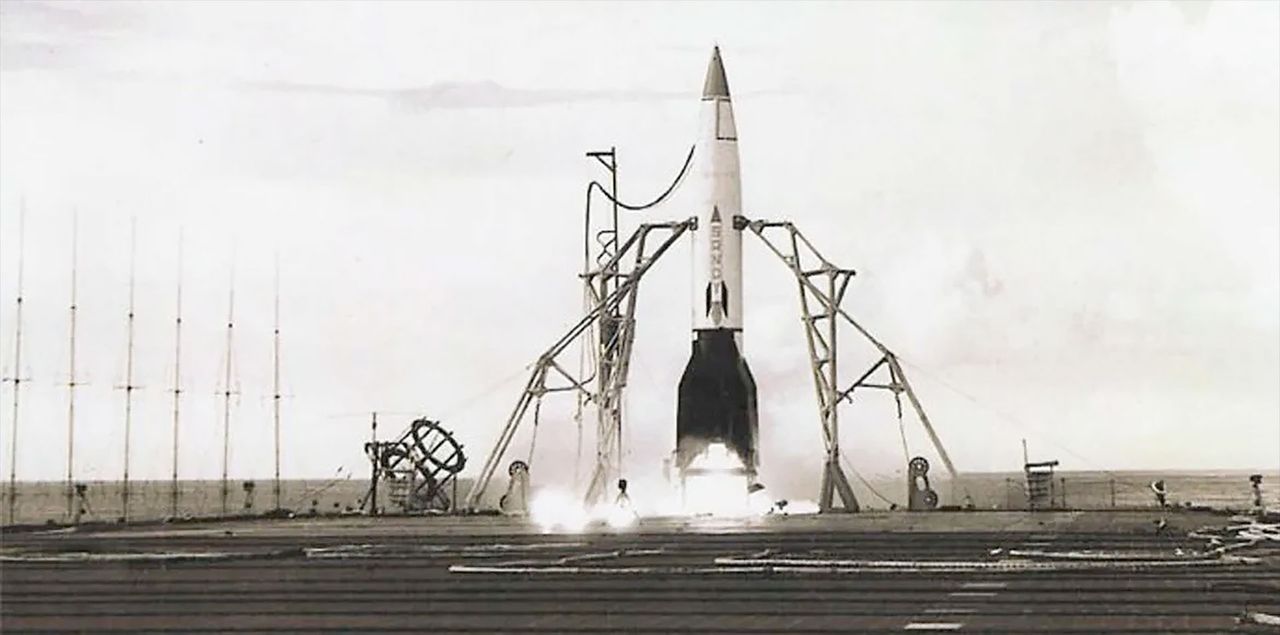
US Navy launches first V-2 ballistic missile from aircraft carrier, September 6, 1947
Operation Sandy marked the inaugural sea-based ballistic missile test, though the rocket failed to achieve its intended altitude.
What happened
On September 6, 1947, the USS Midway, a U.S. Navy aircraft carrier positioned several hundred miles south of Bermuda, launched a V-2 rocket in a mission designated Operation Sandy. This was the first ballistic missile launch from a naval vessel. The V-2 tilted during flight and reached only 15,000 feet (approximately 12,000 feet according to one source cited) before falling back to Earth, making the test unsuccessful. The V-2 rocket itself was a captured German weapon from World War II, designed by Wernher von Braun, and had been brought to the U.S. along with von Braun and other German aerospace scientists through a secret program after the war.
Context
The V-2 was the world's first long-range guided ballistic missile, originally developed as a military weapon for Nazi Germany. The successful recovery of V-2 technology and personnel after WWII prompted Operation Paperclip, which relocated German scientists including von Braun to the United States. Though Operation Sandy's test flight failed, it demonstrated the feasibility of launching ballistic missiles from naval platforms, establishing a concept that would become standard practice in military arsenals. The test represented a critical step in U.S. missile development that would eventually evolve into orbital rocket technology within the following decade. This underscores how military applications—rather than space exploration—formed the historical foundation for rocket technology.