Martian cloud reaching 1,000 miles may be driven by theoretical physics never before observed
A recurring elongated cloud near Mars's Arsia Mons volcano has been successfully modeled for the first time using exotic physics previously considered too theoretical to occur in nature.
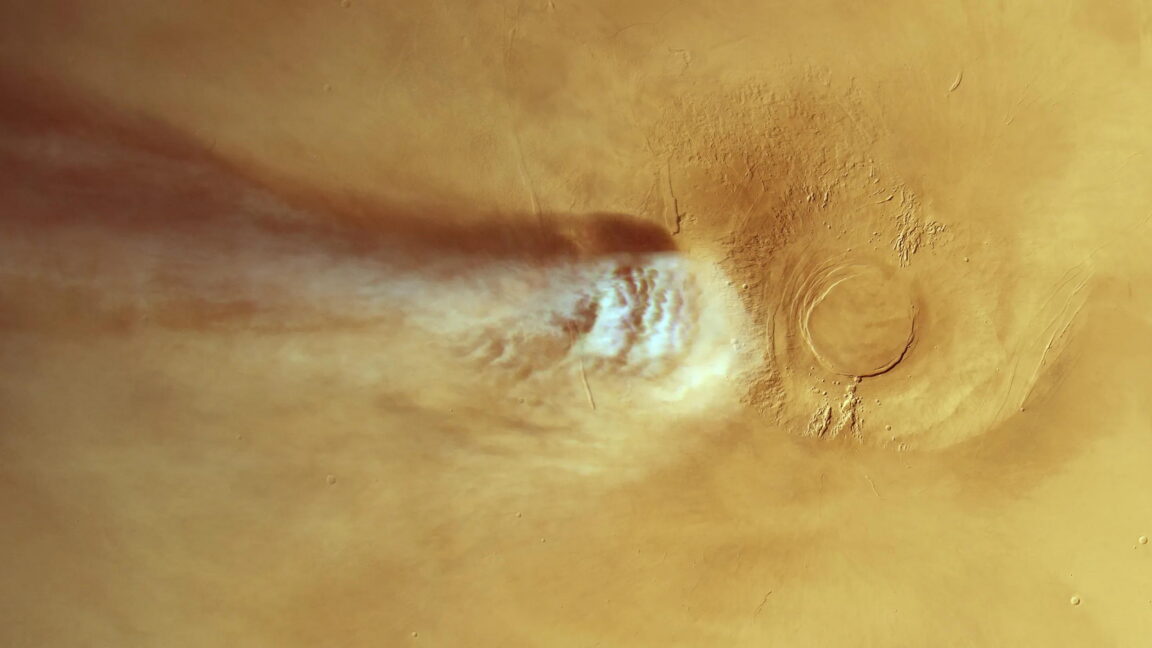
What happened
A thin, extremely long cloud emerges near the Martian volcano Arsia Mons during spring and summer, elongating to over 1,000 miles before dissipating in a cycle that repeats for several months. First recorded by a probe in 2018, the Arsia Mons Elongated Cloud (AMEC) has resisted scientific explanation until researchers at Sorbonne Université recently achieved the first successful model of its formation. Lead researcher Jorge Hernández-Bernal reported that simulating the cloud required incorporating exotic physics that, while described in textbooks, is treated as theoretical and has not been directly observed in any planetary atmosphere before.
Context
The identification of physics in Mars's atmosphere that has never been directly observed elsewhere expands understanding of atmospheric processes across planetary bodies. Successfully modeling the AMEC after years of unexplained observations demonstrates the limits of standard atmospheric theory and suggests that conditions on Mars may exhibit phenomena not yet documented or tested in Earth-based or other planetary science.