James Webb discovers rare O-type star among 70 newborn suns in Carina Nebula's 'Treasure Chest'
The infrared telescope has imaged a compact cluster of young stars embedded in a distinctive cometary globule 7,500 light-years away.
What happened
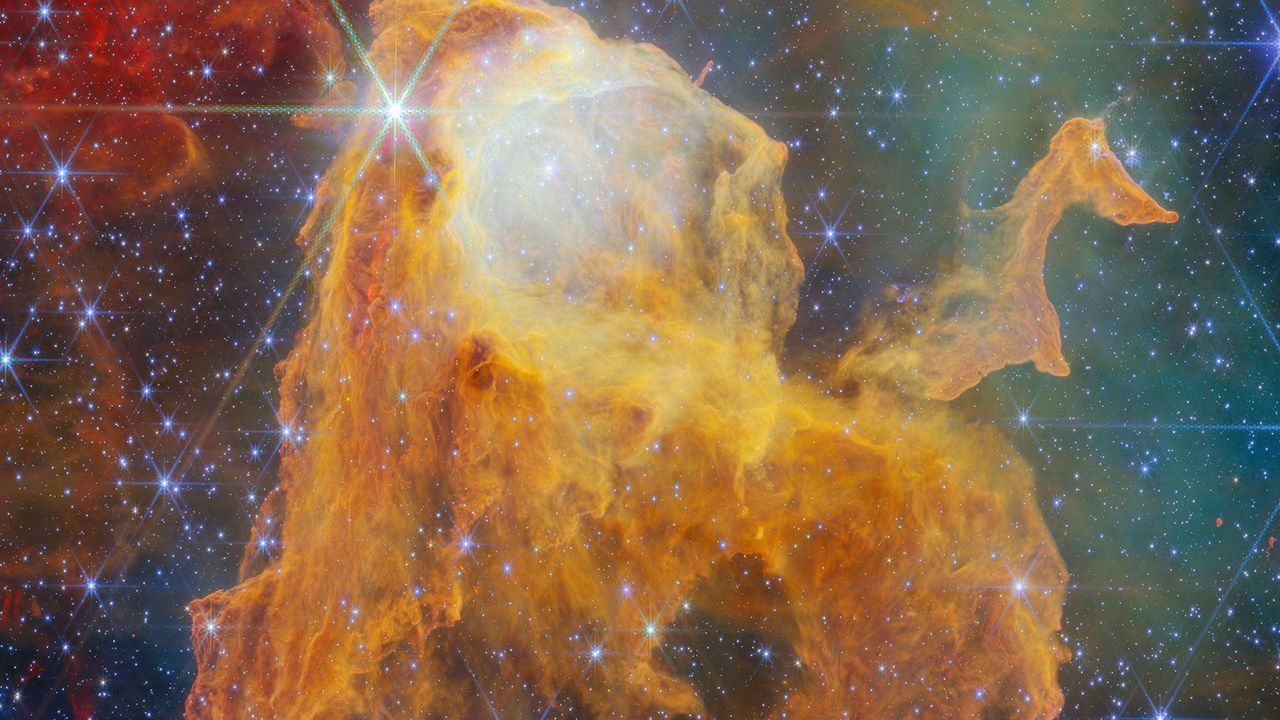
The James Webb Space Telescope captured an image of the Treasure Chest, a cometary globule in the Carina Nebula located 7,500 light-years away in the constellation Carina. The image reveals approximately 70 newborn stars clustered within the cloud of gas and dust. The most massive star in the cluster is a rare O-type star measuring roughly 19 times the sun's mass—extremely large, bright, and short-lived. The cluster is estimated to be around 1.3 million years old, though earlier estimates placed it as young as 100,000 years. Many of the stars remain surrounded by the gas and dust from which they formed.
Context
The Treasure Chest's distinctive shape—resembling an open wooden chest with light spilling out—is being sculpted by radiation and stellar winds from nearby massive stars, particularly Eta Carinae, located about 39 light-years away across the sky. Eta Carinae is the Carina Nebula's most luminous object, containing at least two stars including one about 100 times the sun's mass and roughly 5 million times as luminous, and underwent a dramatic 'Great Eruption' in the 19th century. The radiation and winds from both the young stars within the Treasure Chest and the nearby Eta Carinae system and Trumpler 16 star cluster are gradually dispersing the surrounding gas and dust, which will eventually expose currently hidden stars and erase the globule's current distinctive appearance.
What's disputed
The cluster's precise age is uncertain—current estimates range from 100,000 to 1.3 million years old.