Hubble telescope reveals complexity in ancient Chandelier Cluster, challenging star formation theories
New observations of NGC 6723 show stars of different ages and compositions, upending the long-held assumption that globular clusters formed in a single burst.
What happened
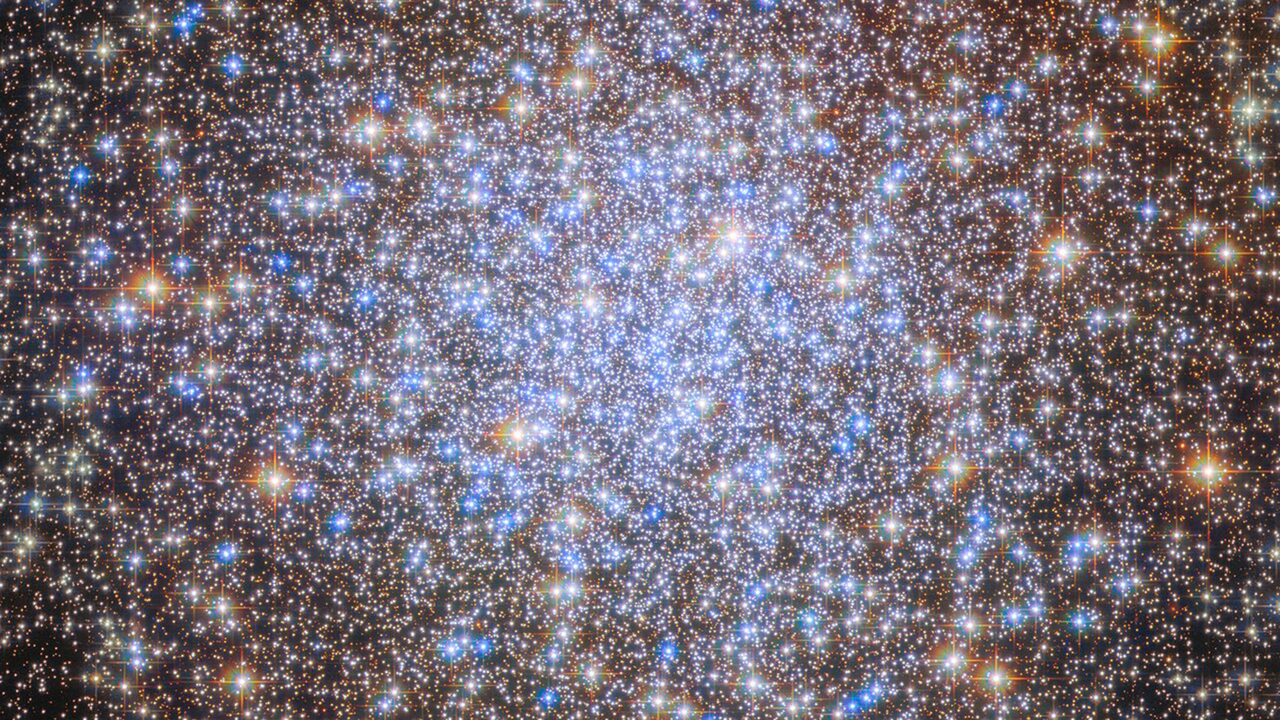
Hubble Space Telescope imaging of NGC 6723, a globular cluster 27,000 light-years away in Sagittarius, reveals that the cluster does not consist of stars of uniform age and composition as once believed. The cluster displays distinct spatial and temporal patterns: blue, younger stars concentrate at the center while orange, older stars dominate the edges. Hubble observations in 2013 and 2014 identified two distinct epochs of star formation, with a second burst occurring approximately 634 million years after the first. The findings contradict the previous model that all stars within a globular cluster formed simultaneously from the same material.
Context
Globular clusters are among the Milky Way's oldest structures, with stars often exceeding 10 billion years in age. Understanding their formation is central to explaining early galaxy evolution. Two competing hypotheses exist: clusters may have formed from rapid collapses of massive gas clouds in the early universe, or they may be surviving cores of ancient dwarf galaxies stripped of outer stars by larger galaxies. The detected complexity—multiple formation epochs and chemical variation—suggests globular cluster histories are more intricate than previously understood, with implications for how such ancient stellar systems assembled and evolved. Globular clusters are not unique to the Milky Way; other galaxies including Andromeda and M87 host hundreds to thousands of them.