Astronomers discover 10-sided cloud structure at Saturn's south pole
A newly observed decagon-shaped atmospheric pattern around Saturn's south pole challenges the assumption that the planet's famous hexagon is unique.
What happened
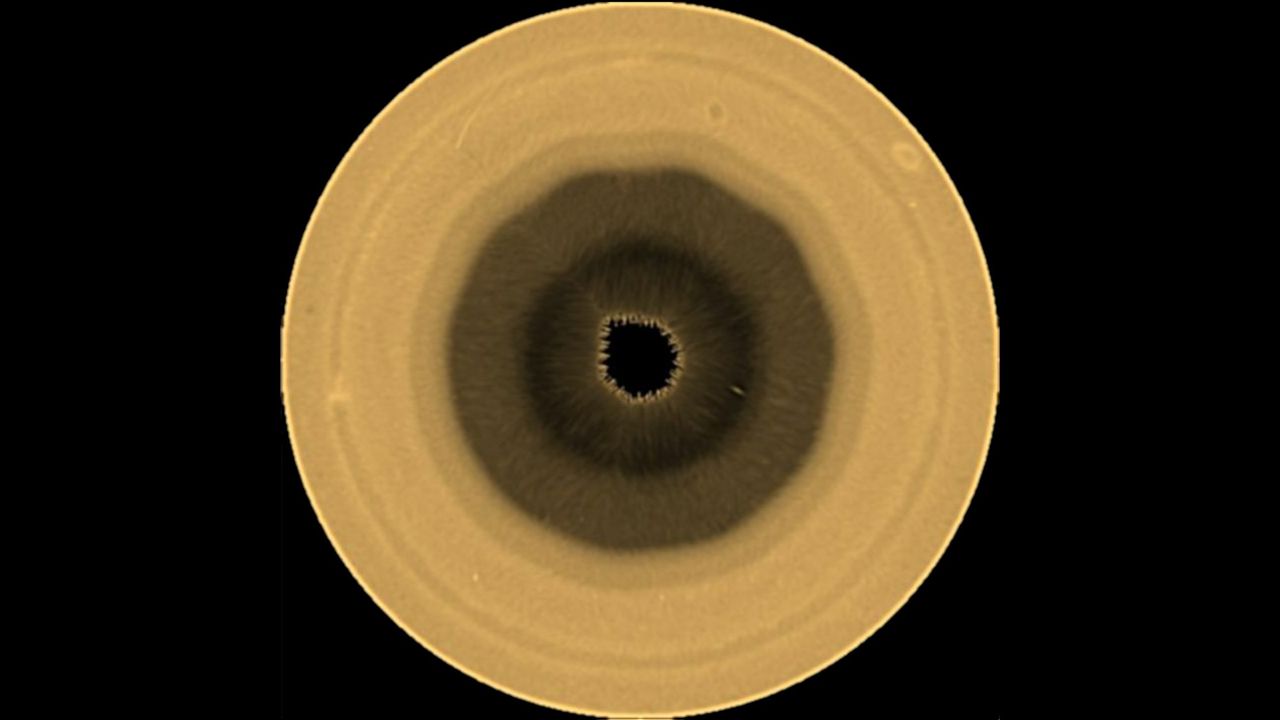
Using NASA's Hubble Space Telescope, astronomers have discovered a 10-sided cloud formation—a decagon—at Saturn's south pole, measuring approximately 104,250 miles wide with each side about 10,425 miles long. The structure was first visible in Hubble images from 2023, as Saturn's southern hemisphere had been obscured from Earth-based observation from 2012 to 2023 due to the planet's axial tilt. The decagon rotates slowly, completing one rotation every approximately 800 days. Unlike Saturn's famous hexagon at the north pole—discovered in 1988 and stable for decades—the decagon displays variation in darkness across its features, suggesting it may still be evolving.
Context
The discovery reveals that the hexagon, previously thought to be a unique singular feature on Saturn, is not isolated to the north pole. Research by the study team suggests both formations result from meandering atmospheric jets: computer simulations of shallow water currents indicate the decagon formed from a meandering wave trapped by a curving jet, similar to the mechanism proposed for the hexagon's formation. The decagon's variation in darkness—unlike the hexagon's uniformly dark features—raises questions about its stability and future evolution, particularly as solar radiation at its 60-degree south latitude is expected to peak around 2032. Understanding the decagon's three-dimensional structure and whether it will stabilize or destabilize could advance understanding of atmospheric dynamics on gas giants.