Japan launches MMX sample-return mission to Mars' moon Phobos
Japan's JAXA launched the Martian Moons eXploration mission on October 19, aiming to land on and return samples from Phobos for the first time.
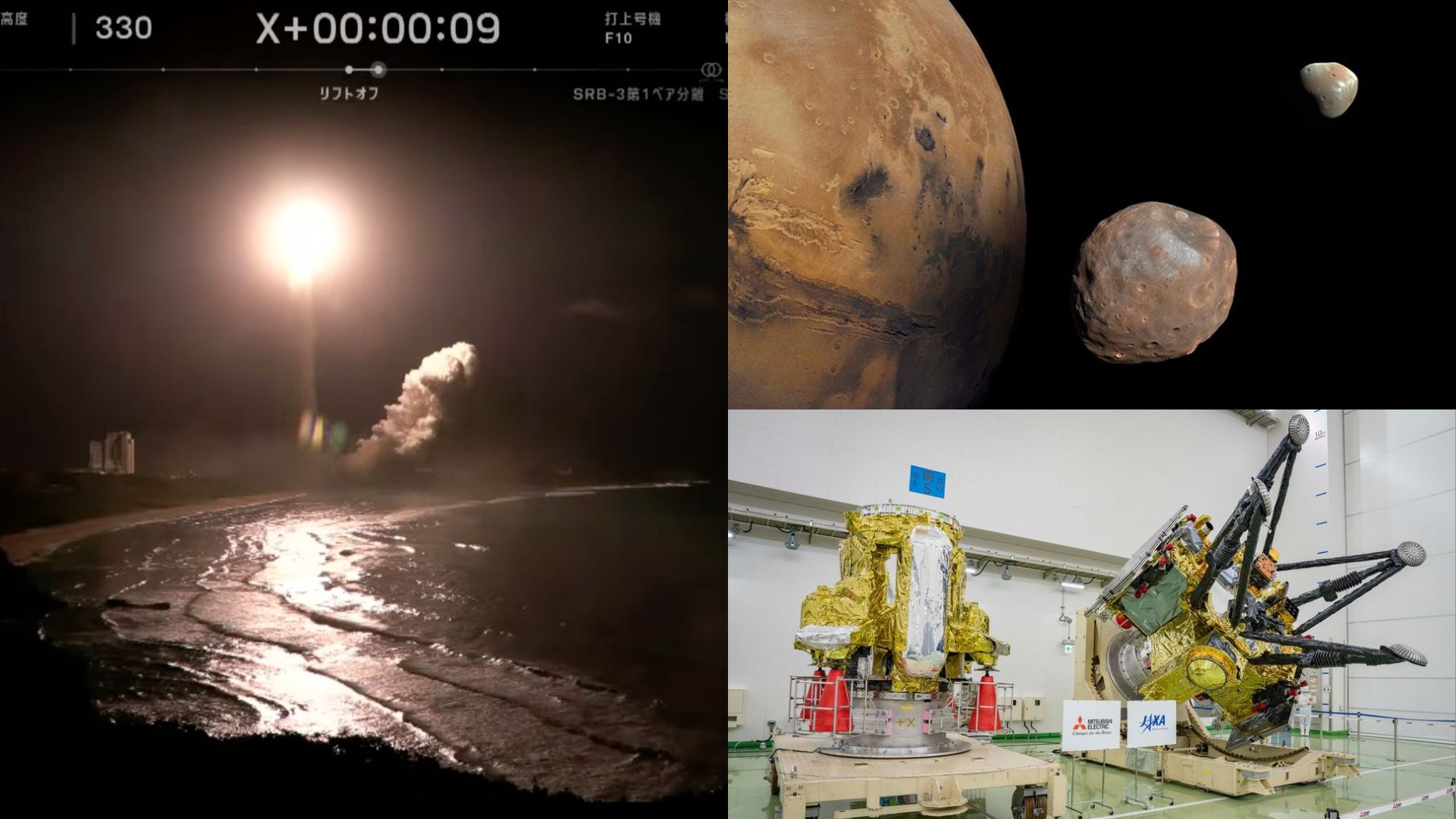
What happened
Japan's JAXA launched the MMX mission from Tanegashima Space Center on an H3 rocket on October 19, 2024, at 3:41 p.m. EDT. The spacecraft is bound for Mars orbit, where it will study Phobos and Deimos over approximately three years beginning in August 2027. MMX will perform two sample-collection landings on Phobos, deploy the IDEFIX rover (a joint France-Germany effort) in late 2028 or early 2029, and conduct flybys of Deimos before departing for Earth in November 2030 with the sample-return capsule expected to land in Australia in 2031. The H3 rocket performed nominally, reaching the planned trans-Mars injection velocity of approximately 24,145 mph about 71 minutes after liftoff.
Context
The mission seeks to resolve a decades-long scientific question about the origin of Mars' moons. Two competing theories exist: one suggests Phobos and Deimos formed from debris after a massive planetary impact, supported by their near-circular equatorial orbits; the other proposes they are captured asteroids, supported by their irregular potato-like shapes and spectroscopic chemical composition. Samples analyzed alongside MMX's in-situ measurements will help distinguish between these hypotheses and provide insights into Mars' geological history, the early solar system's formation, and the development of the inner planets. MMX is a JAXA-led international effort involving NASA and the European Space Agency, with contributions including NASA's MEGANE gamma-ray and neutron spectrometer.