BepiColombo Jettisons Propulsion Module on Final Approach to Mercury
Europe's Mercury orbiter has separated from its transfer module after eight years in transit, positioning itself for orbital insertion in November.
What happened
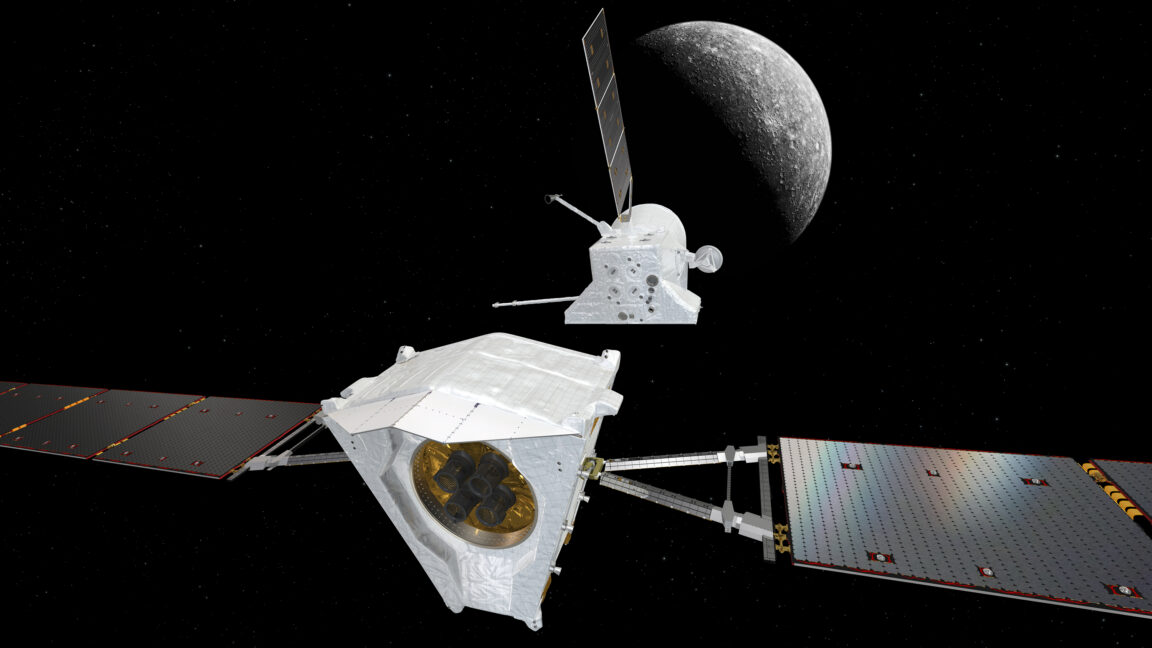
On Thursday, the BepiColombo spacecraft jettisoned its Mercury Transfer Module—the propulsion and power generation section that has powered the mission since its 2018 launch. The separation occurred 39 million miles from the Sun using preprogrammed commands and four springs to push the sections apart. The Mercury Planetary Orbiter and Mercury Magnetospheric Orbiter (nicknamed Mio) remain connected and are now operating independently on their own power systems. Early telemetry confirmed the European orbiter's solar arrays are generating power and charging depleted batteries. The two science orbiters will remain together until December, shortly after entering Mercury orbit on November 21, when they will separate to conduct independent observations.
Context
BepiColombo is undertaking an unprecedented operational challenge—the first controlled separation and disassembly of a multi-spacecraft stack in the harsh environment near Mercury, where temperatures are extreme and solar radiation is intense. The mission required nine planetary gravity assists (flybys of Earth, Venus, and Mercury) across more than 6 billion miles to accumulate enough velocity for orbital capture, a more demanding trajectory than reaching distant Pluto. The propulsion module's separation is critical because it was obscuring several science instruments during transit; those instruments will now see first light for the first time. This mission represents the first time two orbiters will simultaneously study Mercury from orbit, a significant milestone in the scientific exploration of the innermost planet. The separation required the remaining spacecraft to assume all thermal control, power generation, attitude control, and pointing functions—systems that could only be validated after the actual separation event.