Astronomers detect hydrogen signals from billions of years ago using MeerKAT telescope
A research team has successfully isolated hydrogen radio signals from 4-5 billion years ago, demonstrating that hydrogen intensity mapping can work as a practical cosmological tool without requiring supplementary visible-light observations.
What happened
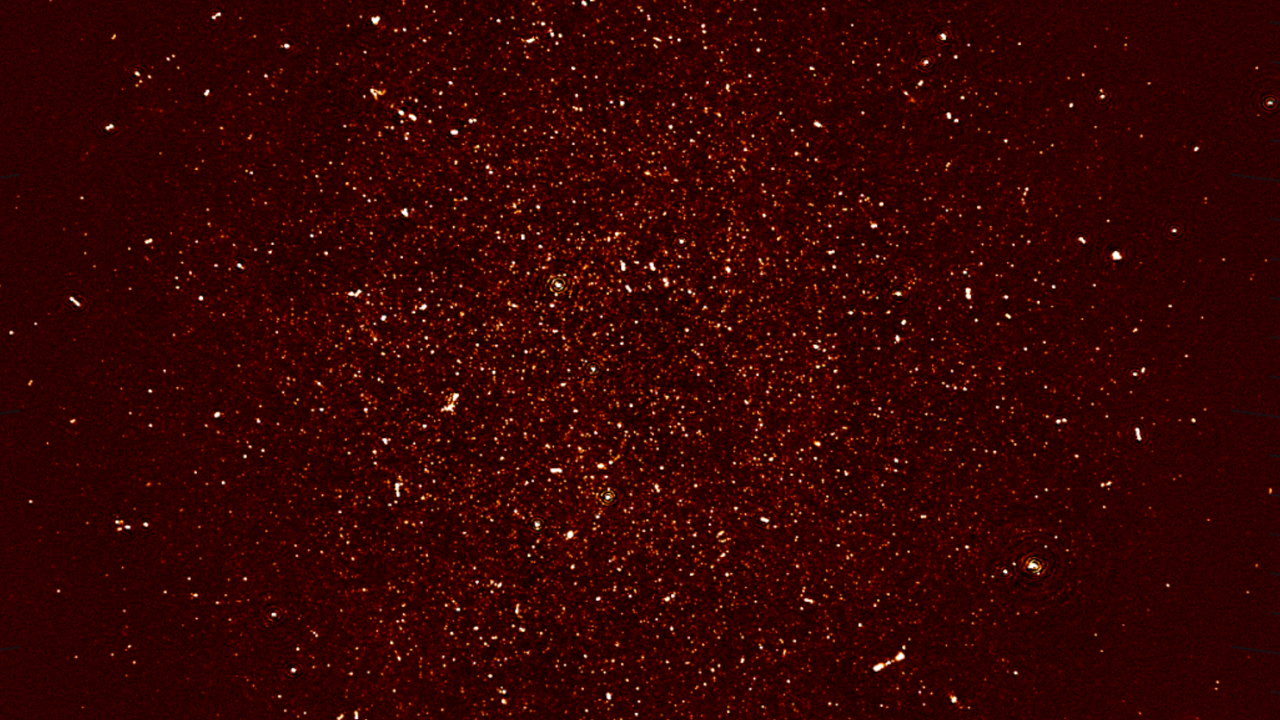
Using 96 hours of observations from the MeerKAT radio telescope array in South Africa, astronomers detected faint radio signals (the 21-centimeter line) emitted by neutral hydrogen from a period when the universe was billions of years younger. The signals came from hydrogen spanning distances of millions of light-years, comparable to the Milky Way-Andromeda separation. This marks the first successful direct detection of hydrogen intensity mapping using radio waves alone, without combining the data with visible-light galactic surveys as previous attempts required. The research, led by Sourabh Paul and including Zhaoting Chen, Laura Wolz, and Mario G. Santos, was published in the July edition of The Astrophysical Journal Letters.
Context
Hydrogen intensity mapping allows astronomers to build three-dimensional maps of the universe's large-scale structure by detecting the collective radio signal from hydrogen across vast cosmic volumes, rather than identifying individual galaxies. The redshift of the 21-centimeter signal reveals how long it has traveled to Earth, indicating the age of the hydrogen detected. This capability is significant for understanding galaxy formation, evolution, and the distribution of matter in the universe. The technique has been considered theoretically promising but challenging due to the extreme faintness of the signal and contamination from foreground emissions and human-made radio interference. The success with MeerKAT—achieved using data from 2018 when the telescope was still in early operations—suggests the technique will become increasingly valuable for major future surveys like the Square Kilometre Array Observatory (SKAO) currently under construction.