James Webb telescope spots candidate for earliest known black hole, 450 million years after Big Bang
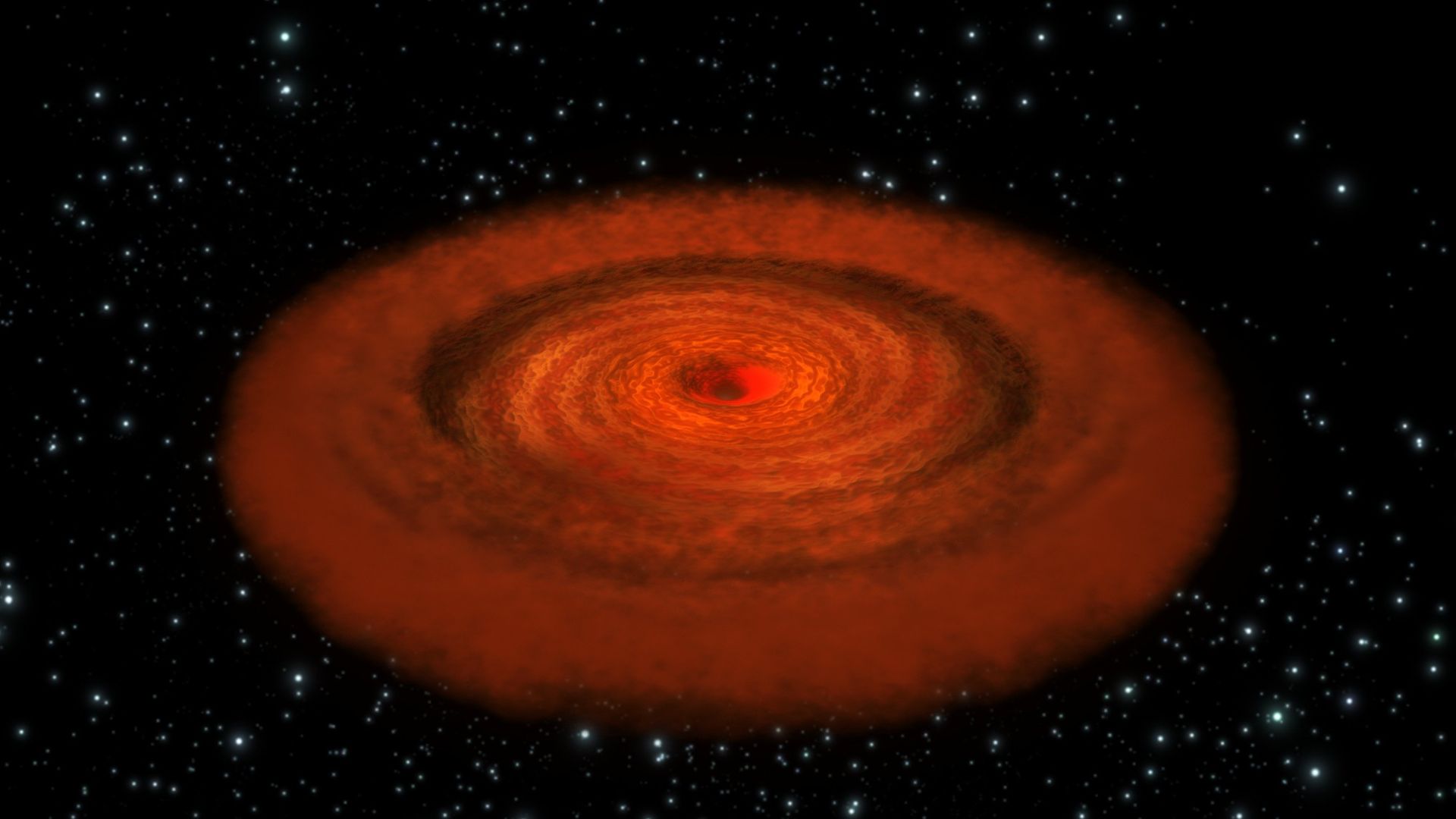
The object CW-LRD-z10 exhibits spectral features consistent with a 'little red dot'—a class of objects thought to be accreting black holes in gas cocoons—but confirmation awaits further observation.
What happened
The James Webb Space Telescope has identified CW-LRD-z10, a compact red object at redshift 10.36, placing it 450 million years after the Big Bang. Spectroscopic analysis measured this redshift using a Lyman-alpha break and found the object exhibits a V-shaped spectral dip, possible iron emission, and extreme redness in mid-infrared wavelengths—features consistent with a 'little red dot.' The spectrum lacks wide hydrogen lines, a telltale signature of little red dots, though this region falls outside the wavelength coverage of the current study. The study was published November 24 in the Astrophysical Journal Letters. If confirmed as a little red dot, it would represent the earliest known example of this mysterious object class.
Context
Little red dots are a recently discovered population of extremely distant, tiny red objects thought by many researchers to be accreting supermassive black holes encased in dense gas, potentially revealing how the universe's earliest black holes formed. The discovery of CW-LRD-z10 at such an early cosmic epoch could provide evidence that little red dots represent an early phase of supermassive black hole formation, addressing a longstanding question about how such massive objects arose when the universe was very young. The object's possible iron emission line would suggest the presence of heavy elements and active black hole accretion, further supporting this interpretation. However, the true nature of little red dots remains debated, with competing theories involving supermassive stars, black hole stars, or dense star clusters, so definitive conclusions about black hole formation cannot yet be drawn.
What's disputed
The object is classified as a 'little red dot candidate' rather than confirmed. Alternative explanations include an older galaxy at redshift 3 (rejected by the research team as inconsistent with the observed color and emission lines) or an unusually luminous star-forming galaxy at the same redshift as the candidate (which cannot be ruled out with current data). The hydrogen emission lines needed to definitively identify a little red dot fall outside the current spectral coverage, and JWST's mid-infrared instrument is scheduled to obtain a more complete spectrum in 2027 to resolve these ambiguities.