Researchers discover massive thermal anomaly beneath Mars's southern hemisphere
Analysis of archival spacecraft data reveals the Red Planet's interior is dramatically asymmetrical, with the southern mantle up to 750 degrees Fahrenheit hotter than the north.
What happened
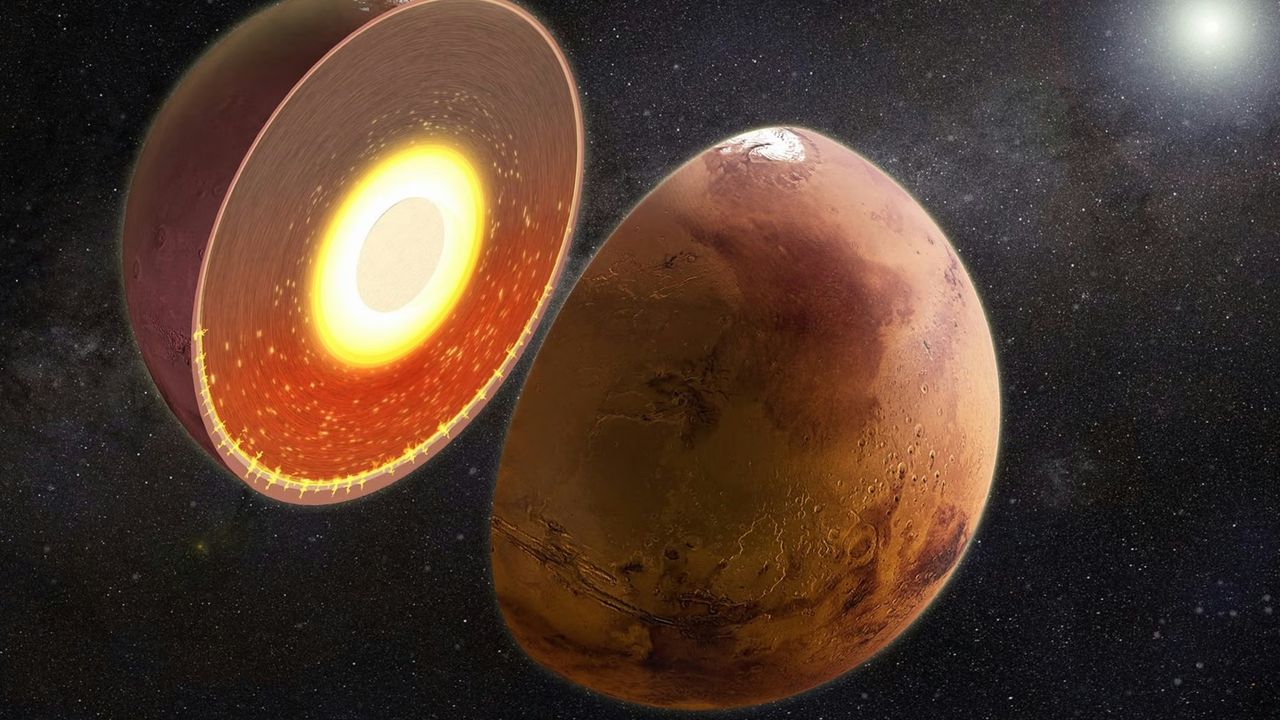
Researchers led by Alexander Berne developed a technique called 'tidal tomography' to analyze gravitational data from three NASA spacecraft (Mars Global Surveyor, Mars Odyssey, and Mars Reconnaissance Orbiter) spanning decades. The analysis revealed that Mars's southern hemisphere mantle is between 390 and 750 degrees Fahrenheit (200–400 degrees Celsius) warmer than the northern mantle, and warm enough to potentially remain partially molten. This finding, published in Nature on August 27, contradicts the typical assumption that planetary interiors are spherically symmetric. The discovery helps explain previously puzzling observations: NASA's InSight lander detected seismic waves dissipating more quickly in the south, and anomalous magnetic properties in iron-bearing minerals are now consistent with the hotter southern temperatures.
Context
Mars's interior asymmetry parallels known surface differences—the north consists of relatively flat lowlands that may once hosted an ocean, while the south has cratered highlands with crust 15.5 miles thicker than the north. The thermal anomaly has implications for understanding Mars's past habitability and volcanic activity. The leading explanation is that a giant impact over four billion years ago gouged out the northern lowlands, allowing that region's mantle to cool faster, while the thicker southern crust may have acted as an insulating lid. However, researchers acknowledge the origin of this north–south divide remains unresolved. The tidal tomography technique could be applied to study other planetary bodies including Mercury and Jupiter's moons.
What's disputed
The cause of Mars's north–south divide is acknowledged as unsettled; whether surface and interior asymmetries share the same origin is unclear. The leading impact-basin hypothesis could be tested through higher-resolution gravity data looking for magma intrusions beneath the thick southern crust.