JWST captures young star-forming region in Large Magellanic Cloud
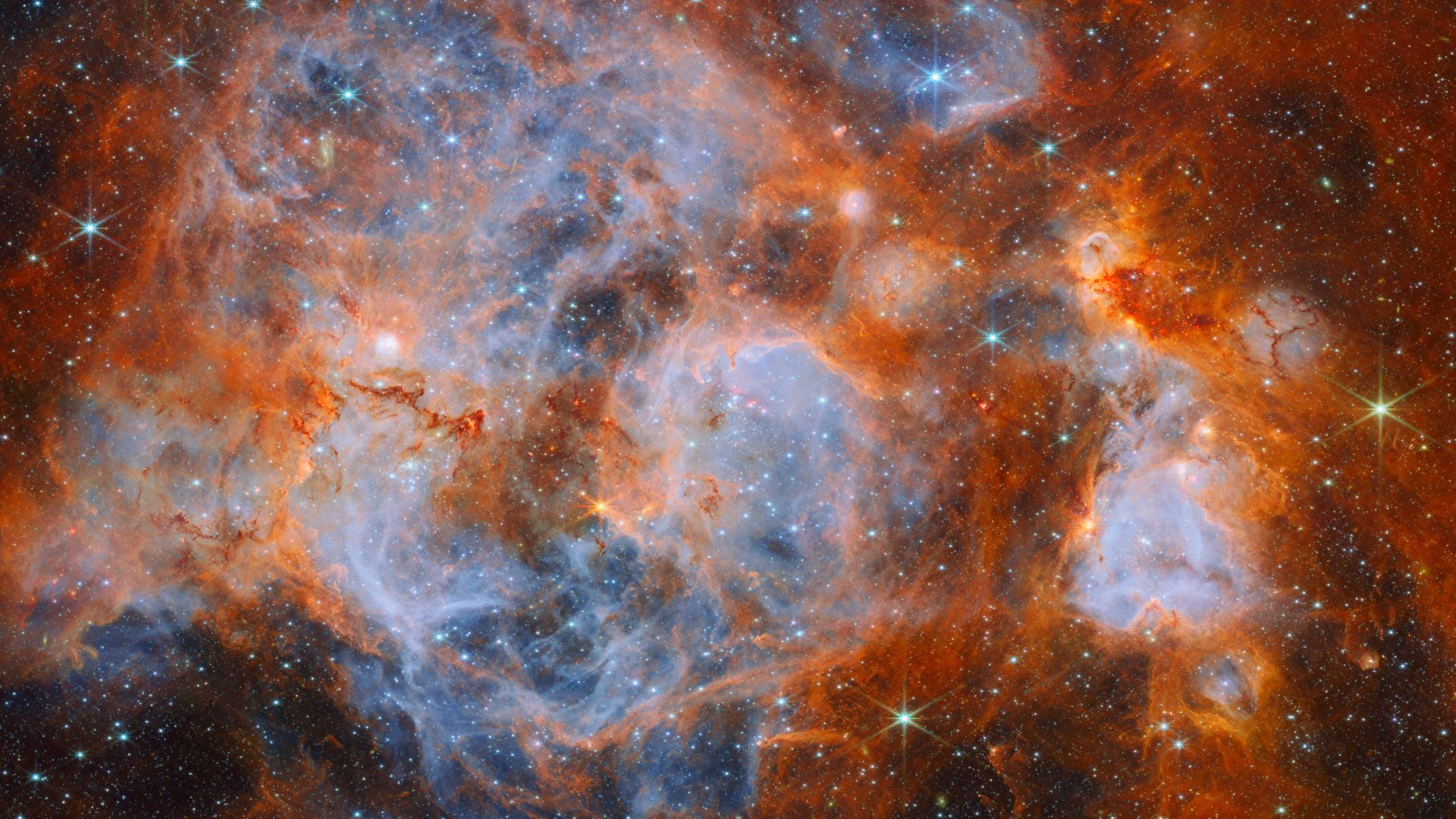
The James Webb Space Telescope imaged N159, a 230-light-year-wide emission nebula 161,000 light-years away that is less than 3 million years old.
What happened
The James Webb Space Telescope captured detailed imagery of N159, a star-forming region in the Large Magellanic Cloud satellite galaxy. The nebula spans 230 light-years and contains reddish molecular hydrogen filaments, blue ionized hydrogen gas clouds energized by ultraviolet radiation from young stars, and orange clouds of polycyclic aromatic hydrocarbons. N159 is estimated to be younger than 3 million years old, making it one of the youngest star-forming regions in the Large Magellanic Cloud, and exhibits notably lower metal content than typical Milky Way star-forming regions.
Context
The lower metallicity of N159 may provide insight into stellar nurseries that existed in the early universe, allowing astronomers to study stars at varying evolutionary stages including pre-main-sequence objects still accreting from the interstellar cloud. This observation offers a comparative window into how star formation processes operated under different chemical compositions than those prevalent in our galaxy today. Polycyclic aromatic hydrocarbons observed in the nebula may account for approximately 30% of all carbon in the universe according to the Department of Energy.