Hubble captures detailed image of giant superbubble in nearby galaxy
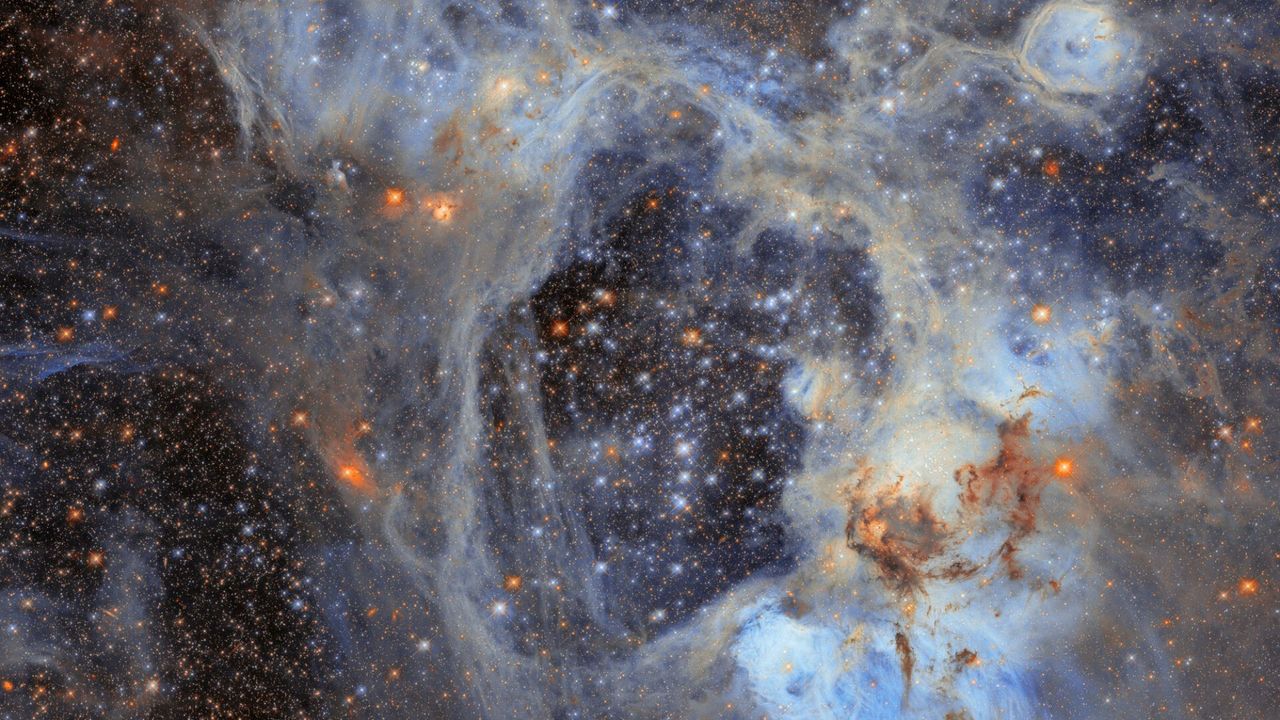
The Space Telescope has revealed a massive 210-by-140 light-year void at the center of nebula N44 in the Large Magellanic Cloud, likely created by stellar explosions or winds.
What happened
The Hubble Space Telescope has imaged nebula LHA 120-N44 (N44) in the Large Magellanic Cloud, approximately 160,000 light-years from Earth. At the center of this star-forming nebula is a giant void called a superbubble, measuring approximately 210 by 140 light-years across. The leading theory holds that supernovae or stellar winds from stars at the bubble's center swept away gas, creating the observed void surrounded by a gaseous shell. The nebula is an emission nebula—energized by surrounding stars, which causes the gas to glow brightly. Hubble's survey of the region identified nearly half a million stars in and around the cluster, with 30,000 in early stages of formation.
Context
N44 provides astronomers with favorable conditions to study both star formation and stellar evolution at a detailed scale. The continued appearance of new stars forming within the shell surrounding the superbubble demonstrates ongoing star birth in the region shaped by these powerful energetic events. Previous observations by Hubble in 2012 and 2021, combined with X-ray data from the Chandra Observatory (resulting in a 2011 study of supernova shock waves), indicate sustained scientific interest in understanding how such large-scale voids form and influence stellar activity in nebulae.
What's disputed
The mechanism behind the superbubble's formation remains under study; while stellar explosions and winds are the leading explanation, the source indicates refinement of this theory through future research is anticipated.