James Webb Telescope Observes One of Earliest Known Supernovas, Caught Just Days After Ignition
The JWST detected a supernova erupting 1.15 billion years after the Big Bang, observed without gravitational lensing assistance.
What happened
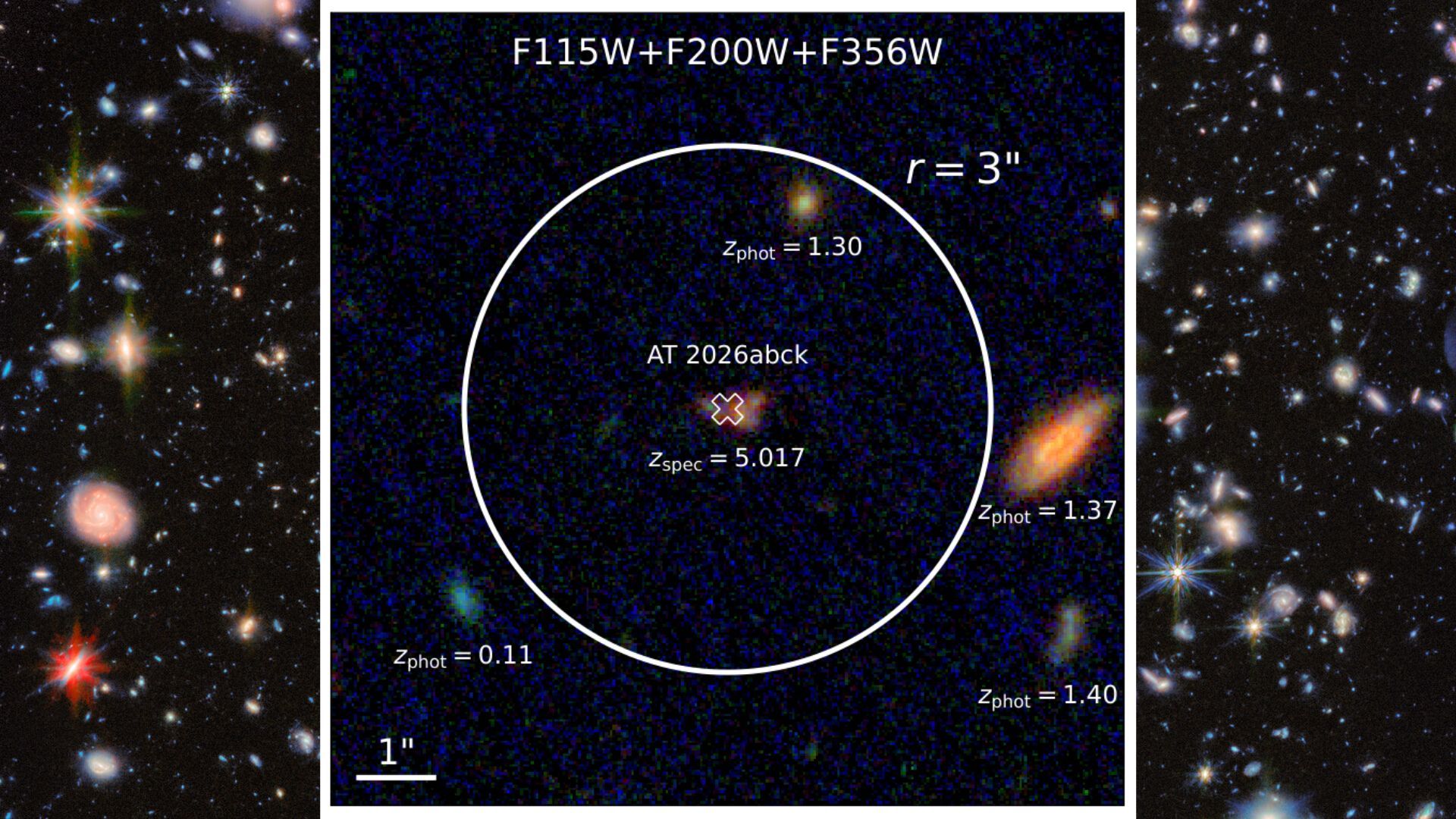
Astronomers using the James Webb Space Telescope discovered supernova AT 2026abck, which exploded approximately 1.15 billion years after the Big Bang and was observed on August 7, 2024. The explosion occurred 12.5 billion years ago, and the team observed it just four to ten days after ignition in the supernova's reference frame. The supernova reached peak brightness of approximately 8 billion times the Sun's luminosity—nearly as bright as the entire Milky Way—and heated to over 30,000 degrees Fahrenheit. Its ejected material expanded to a radius of roughly 46 astronomical units. The discovery was made as part of JWST's NEXUS Treasury program and uploaded to arXiv on September 29 without peer review.
Context
This observation is significant because it captures a supernova at an extreme distance without gravitational lensing, a cosmological magnification effect typically required to detect explosions this distant. The supernova's host galaxy ID101411 contains 6.3 billion solar masses and produces stars over ten times faster than the Milky Way, reflecting the conditions of the early universe. Cosmological time dilation made the explosion appear six times slower to Earth observers than it actually occurred—71 Earth days passed between JWST's previous observation on May 28 and the detection on August 7, though only about 12 days elapsed in the supernova's own timeframe. This extreme distance and ancient epoch provide a window into stellar physics and star formation during an era when the universe was less than one-tenth its current age.
What's disputed
The nature of the explosion remains uncertain. Study authors suggest it may be a superluminous supernova—among the rarest and most powerful explosions known, releasing tens to hundreds of times more energy than conventional core-collapse supernovas—but note their interpretation is preliminary and require follow-up observations to confirm the explosion type.