NSA Releases 1992 Pentagon Review of Cold War Aircraft Losses and Missing Servicemen
Declassified records show the Defense Department examined 21 Cold War aircraft incidents involving 131 unaccounted-for servicemen, noting that official explanations for some losses may have differed from what actually occurred.
What happened
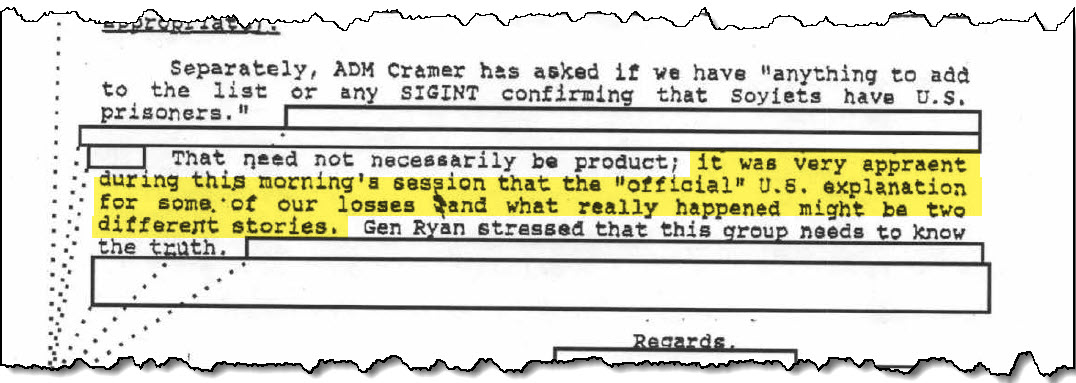
The National Security Agency released records in September 2025 documenting a June 1992 Pentagon task ordered by the Secretary of Defense to examine Cold War reconnaissance losses and determine whether missing American personnel may have been captured by the Soviet Union, China, or North Korea. A Joint Staff memorandum dated June 17, 1992, chaired by Maj. Gen. Ryan, recorded that officials wanted to examine cases where the 'official' U.S. explanation for losses and what actually happened might represent "two different stories," though the memo does not identify which specific incidents prompted this observation. A separate Air Force and Navy summary identified 21 aircraft loss incidents between April 1950 and April 1969, involving 131 unaccounted-for servicemen. An accompanying chronology documented approximately 30 airborne reconnaissance missions during 1949-1960 that resulted in international incidents or manned aircraft losses, with three additional losses during 1961-1973: a U-2 shot down over Cuba in 1962, the USS Pueblo captured off North Korea in 1968, and an EC-121 shot down over the Sea of Japan in 1969. The released materials remain partially classified, with some portions withheld by the Office of the Secretary of Defense-Joint Staff.
Context
These records reveal that decades after Cold War reconnaissance incidents, Pentagon officials were formally examining whether the government's public accounts of aircraft losses aligned with classified operational facts. The 1992 review occurred at a moment when Cold War tensions had recently eased, making a historical accounting feasible. The notation that official and actual explanations might differ for some losses suggests an institutional acknowledgment of potential gaps between public and classified records, though the documents do not establish false explanations or survival of missing personnel. The continued classification of portions of these 1992 documents—over 30 years after the incidents themselves and after the Cold War's end—indicates that some dimensions of these losses remain sensitive to national security concerns.
What's disputed
The documents do not establish that missing U.S. servicemen survived in foreign custody, nor do they establish that official explanations for particular aircraft losses were false. The specific losses for which official and actual accounts allegedly differed are not identified in the released portions.