Nancy Grace Roman Space Telescope launches successfully on SpaceX Falcon Heavy rocket
The $4 billion infrared observatory lifted off August 30 from Cape Canaveral and will spend 90 days traveling to the Sun-Earth Lagrange Point 2, where it will conduct wide-field surveys and direct imaging of exoplanets.
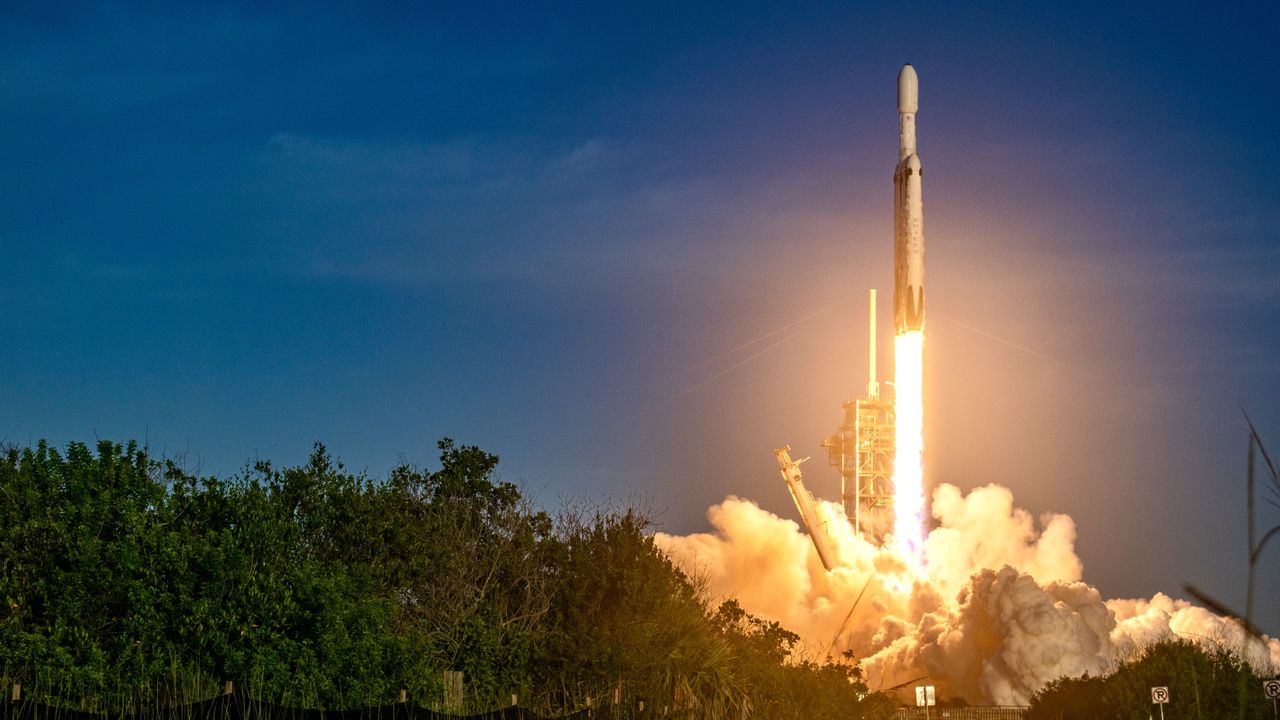
What happened
The Nancy Grace Roman Space Telescope launched at 7:26 a.m. EDT on August 30 aboard a SpaceX Falcon Heavy rocket from Cape Canaveral, Florida. Project manager Jackie Townsend reported that all post-launch systems performed as intended, with deployments going smoothly. The telescope is now undergoing standard post-launch procedures including outgassing and temperature reduction. Roman will travel approximately 1 million miles to the Sun-Earth Lagrange Point 2, a gravitationally stable location also home to the James Webb Space Telescope, where it will spend a 90-day commissioning period before beginning operations.
Context
Roman carries two primary instruments: a Wide Field Instrument (WFI) designed to survey large areas of the cosmos for transient phenomena like supernovas and fast radio bursts, and a state-of-the-art active coronagraph to image exoplanets by blocking starlight. The WFI will observe in infrared wavelengths, enabling detection of objects obscured by dust and gas as well as distant universe objects whose light has been redshifted. Roman's data output will be substantial—approximately 500 terabytes annually compared to Hubble's 400 terabytes across 35 years of operation. The mission addresses long-standing astronomical questions about dark matter, dark energy, and the so-called Hubble tension regarding cosmic expansion rates. Completed under budget and ahead of schedule after over a decade of development, Roman represents a complementary capability to JWST's narrow, deep observations through its wide-field, shallow approach to infrared astronomy.