Venus enters crescent phase as it swings toward inferior conjunction with Earth
The planet's thinning crescent becomes visible through small telescopes this September, revealing orbital geometry that has fascinated astronomers since Galileo.
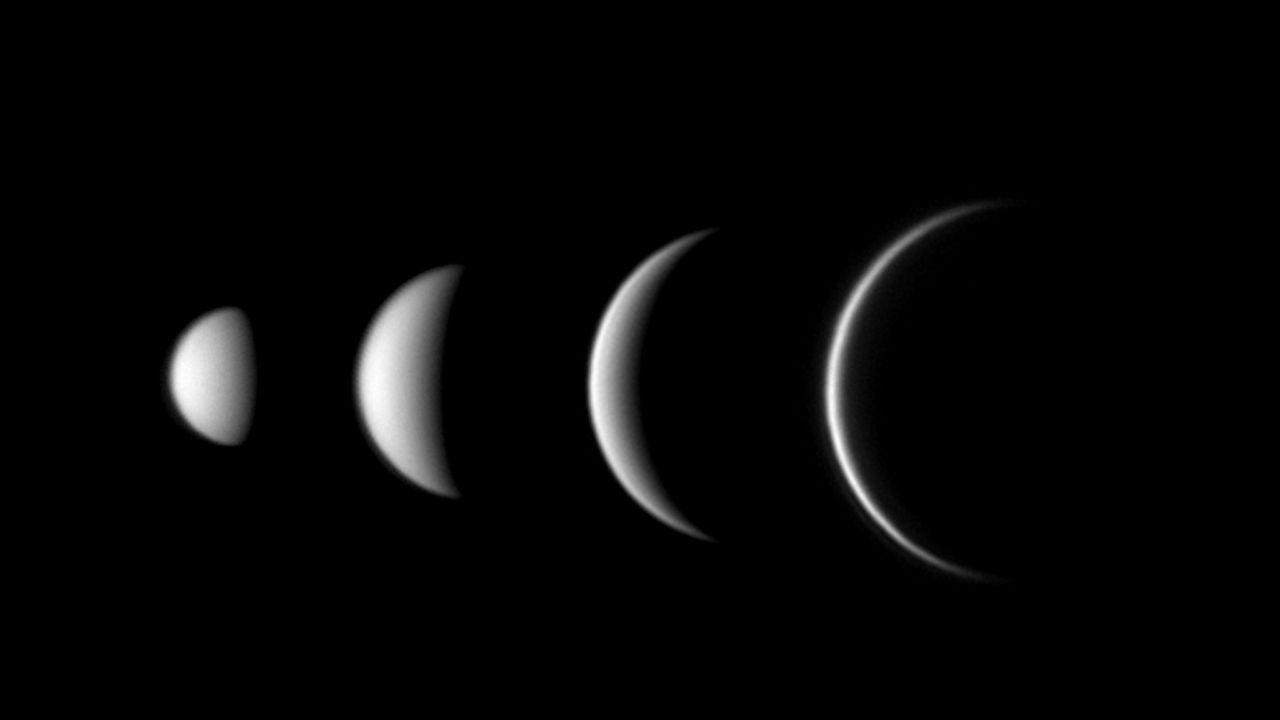
What happened
Venus is moving closer to Earth as it swings around the inner side of its orbit toward inferior conjunction on October 24, when it will pass roughly between Earth and the sun. As it does so, its illuminated disk—currently 36% lit—is shrinking to a crescent while its apparent size grows larger due to proximity. The planet reaches its peak brightness on September 18 when it will shine at magnitude -4.8 while only 26% lit, after which it will become an increasingly dim crescent. Through a small telescope this week, Venus's disk is visible dimming from 36% to 32% lit as September progresses. At inferior conjunction, Venus will be 0.27 AU (25 million miles) from Earth, compared to a maximum distance of 162 million miles.
Context
The crescent phase reveals planetary geometry that would be impossible if Venus orbited Earth, as the traditional Ptolemaic model claimed. When Galileo observed Venus's phases through a telescope in the early 17th century, the full range of phases he documented contradicted geocentric theory and helped establish the heliocentric model. Observing Venus as a crescent demonstrates that we are viewing it increasingly from behind, toward its night side, with only one edge illuminated by the sun—the same principle that creates lunar phases. The observation remains one of the simplest ways to understand planetary orbits and humanity's position in the solar system. Venus remains visible in the western twilight after sunset throughout September, though it is becoming more challenging to observe from mid-northern latitudes as it sinks lower toward the horizon.