Hubble Confirms Mysterious 10-Sided Atmospheric Wave Around Saturn's South Pole
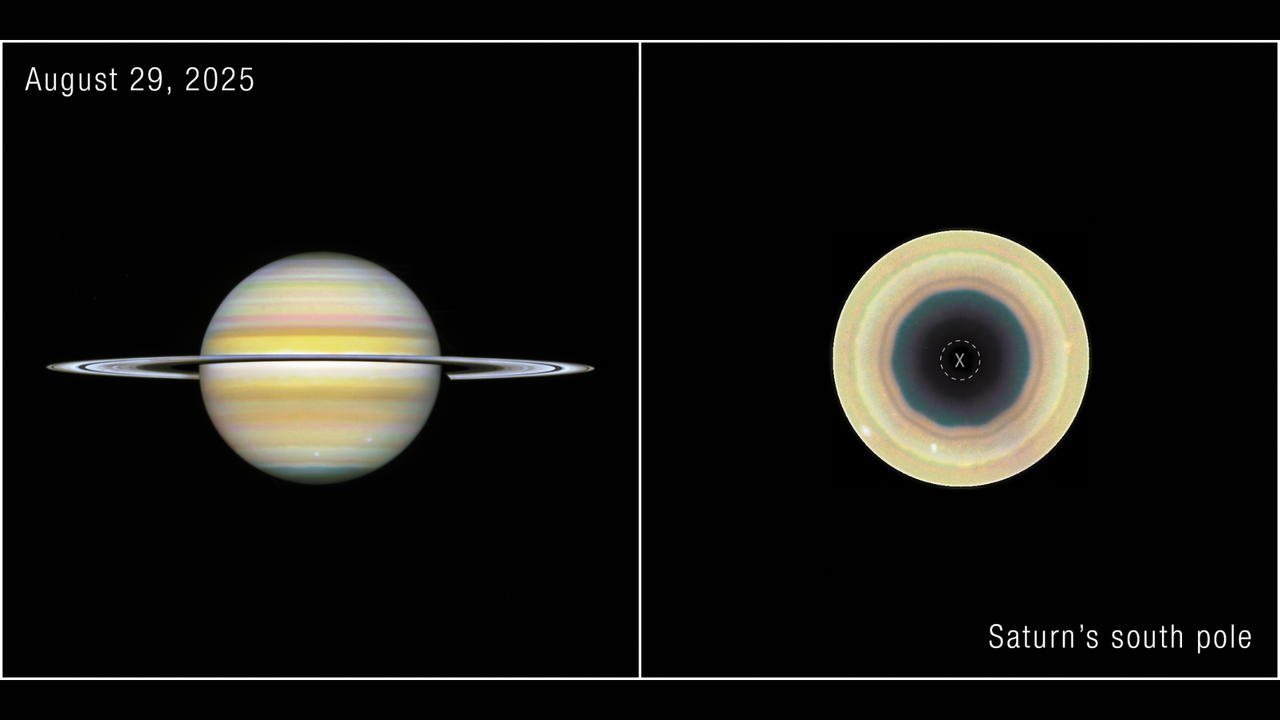
A newly formed decagonal jet pattern has emerged around Saturn's south pole, appearing to strengthen and evolve in real time.
What happened
The Hubble Space Telescope has captured high-resolution images of a 10-sided atmospheric wave, or decagon, surrounding Saturn's south pole. The feature began forming in 2023 and was first spotted by ground-based observatories and amateur astronomers in 2024 using the Planetary Virtual Observatory Laboratory. Hubble observations in 2025 showed the wave moving into its decagonal structure, and the pattern persists through multiple atmospheric layers and extends beyond cloud tops into a large jet stream. The Cassini spacecraft, which orbited Saturn from 2004 to 2017, did not observe this feature, suggesting it had not yet formed during that mission.
Context
This discovery is significant because Saturn's other well-known multisided atmospheric pattern—a hexagon at the north pole—has remained stable for over 40 years, making the rapid emergence and visible strengthening of the southern decagon unusual and poorly understood. The south pole is currently visible from Earth due to Saturn's orbital position in its roughly 29-year solar orbit, enabling prolonged observation of this developing phenomenon. Understanding how this atmospheric structure formed and evolved could illuminate how atmospheric patterns develop on large gas giants more broadly. Scientists plan to continue monitoring the decagon using Hubble and the James Webb Space Telescope to determine how the wave is generated and what it reveals about gas giant atmospheres.