Researchers observe Einstein's gravity operating at quantum scale in first-of-its-kind experiment
A team led by Ron Folman at Ben-Gurion University has measured how gravity affects quantum waves, providing the first hints that general relativity may operate in the quantum realm.
What happened
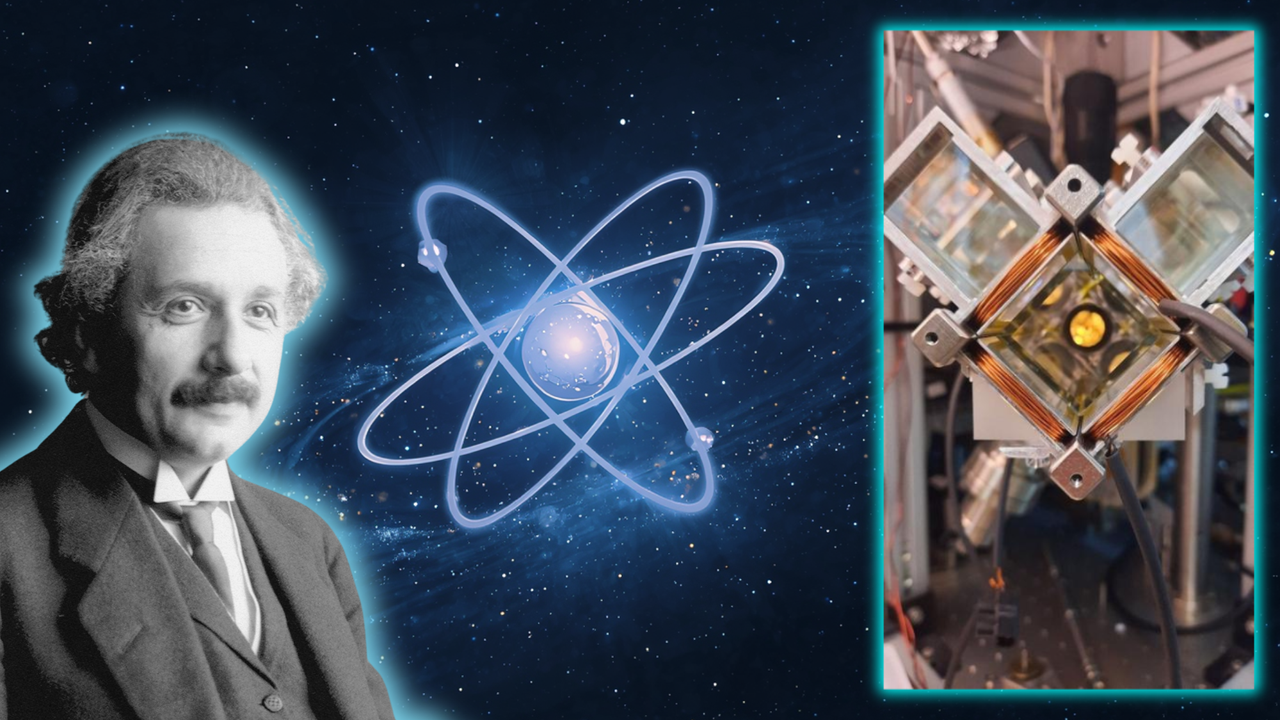
Researchers used the Quantum Galileo Interferometer to split quantum waves associated with rubidium atoms cooled near absolute zero and placed in quantum superposition. One path was held stationary via magnetic fields counteracting gravity; the other was allowed to fall freely. When the waves recombined, the team measured changes to the falling wave using interference effects, marking the first time gravity's effects on a quantum wave's phase were directly measured. The experiment tested Einstein's equivalence principle—that gravity and acceleration are indistinguishable—at quantum scales. Results were published in Science Advances on September 2.
Context
General relativity and quantum mechanics are the two foundational pillars of modern physics, yet they remain theoretically incompatible; no unified quantum theory of gravity exists. The equivalence principle is central to general relativity and underpins Einstein's theory. By demonstrating this principle holds at quantum scales, the experiment suggests a potential pathway toward reconciling these theories, though it does not constitute a complete theory of quantum gravity. The experiment shows quantum mechanics' predictions continue to hold when extended into gravitational regimes, advancing understanding of where and how the two theories might be unified.